Biography
A little about my background, interests, and life beyond mathematics.
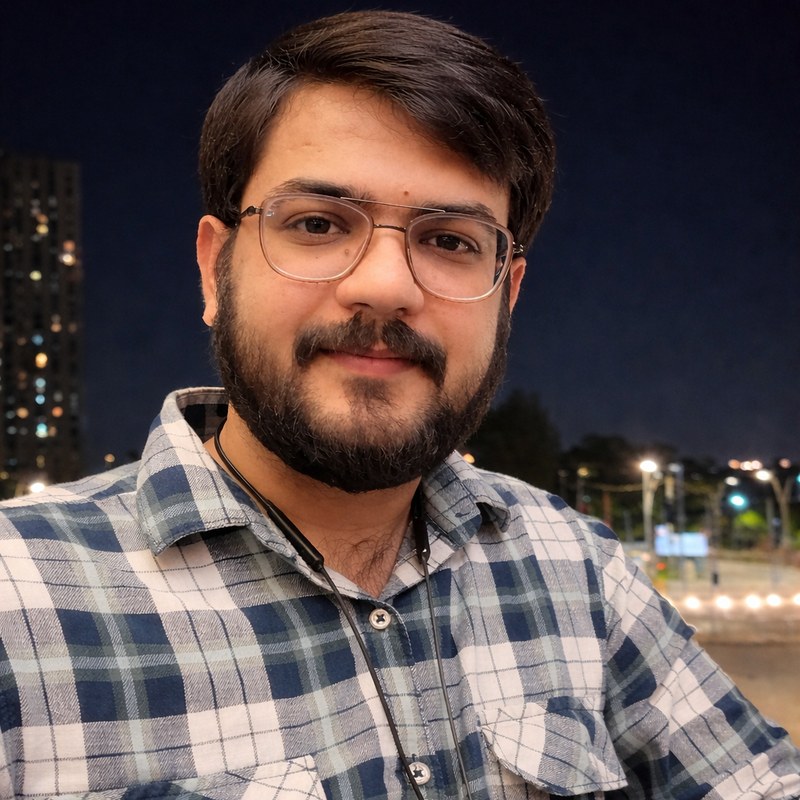
Deep H. Makadiya
Post-doctoral Fellow · Bar-Ilan University
Official name: Makadiya Deepkumar Hasamukhbhai (see more)
Hometown: Rajkot, Gujarat, India
Currently lives in: Ramat-Gan, Israel
Languages: English, Hindi and Gujarati
Programming skills: LaTeX, C++, Python, SageMath and GAP
Hobbies & interests: Chess, philosophy, puzzle solving and exploring places
In Brief
I earned my B.Sc. in Mathematics from the Maharaja Sayajirao University of Baroda in 2017, followed by an M.Sc. from the Indian Institute of Technology Bombay in 2019. In January 2020 I returned to IIT Bombay to pursue a Ph.D. under the supervision of Prof. Shripad M. Garge. I submitted my thesis, “Some properties of twisted Chevalley groups,” on 1 January 2025, and successfully defended it that May.
Since October 2025 I have been at Bar-Ilan University as a postdoctoral fellow, working with Prof. Elena I. Bunina.
My research lies in group theory, with a focus on twisted Chevalley groups. These groups can be viewed as fixed-point subgroups of Chevalley groups under an involution induced by a symmetry of the Dynkin diagram together with an involution of the base ring. Much of my work so far has explored how their structure behaves when they are defined over rings rather than fields: which subgroups are normal, what their normalizers look like, and how their elements can be factored into triangular components. With Prof. Bunina I am currently studying their automorphisms, first over local rings and ultimately over general commutative rings.
Early Years
I was born and brought up in a small village in Gujarat, India — Jam Timbadi, in Upleta Taluka of Rajkot District.
I completed my early education, from Standards 1 to 7, at the local village school, Shree Jam Timbadi Takula Shala. For Standards 8 to 12 I studied at Shree Sandipani Vidhya Sankul, Dhoraji, where I lived in the hostel.
I have been particularly fond of mathematics since childhood. I suppose I owe some of that to my parents, both of whom have a strong command of basic mathematics. I was also fortunate to have excellent mathematics teachers throughout my school years, especially Mr. Dinesh K. Kanasagara, who taught me mathematics in Classes 11 and 12. His way of teaching and, more importantly, his way of looking at mathematics had a lasting influence on me. Inspired by him, my dream at the time was to become a high-school mathematics teacher.
So, despite the prevailing idea in India at the time that a bright student should either become an engineer or a doctor — and against my parents’ initial wishes — I chose to pursue my dream by enrolling in a B.Sc. in Mathematics. That is how my mathematical journey began.
Fun fact: I eventually did become a doctor… just a Doctor of Philosophy. ☺️
A Road from “Mr.” to “Dr.”
My initial plan was quite straightforward: complete a B.Sc. and an M.Sc. in Mathematics, followed by a B.Ed. — the qualification I would need to become a high-school mathematics teacher.
For my B.Sc. I chose The Maharaja Sayajirao University of Baroda, one of the leading universities in Gujarat. My original plan was to continue there for my M.Sc. as well. However, during the final year of my B.Sc., I learned that the IITs — typically known as India’s premier engineering institutions — also offered M.Sc. programmes in Mathematics. To get in, I had to clear the IIT Joint Admission Test for M.Sc. (IIT JAM). I gave it a shot and ended up with an All India Rank of 10 out of 10,834 candidates! That led me to IIT Bombay for my M.Sc., largely because I thought the IIT brand name would look great on the résumé of a future high-school mathematics teacher.
But IIT Bombay had other plans for me. Being surrounded by such a mathematically rich environment completely changed my perspective. My dream evolved into something bigger: I now wanted to become a university professor and devote myself to mathematical research. And so, after my M.Sc., I stayed on at IIT Bombay for a Ph.D.
I joined Prof. Shripad M. Garge and began my research. Over the years, my academic progression looked something like this:
learning about Lie algebras and root systems → Lie groups → Chevalley groups → twisted Chevalley groups → two papers → submit Ph.D. thesis → one more paper → thesis defence → Ph.D. degree.
And there it was: officially, Dr. Deep H. Makadiya. 🎓
Want the long version? Read the blog post How I Ended Up in Mathematics.
Life after Ph.D.
In October 2025 I joined Bar-Ilan University as a postdoctoral fellow working with Prof. Elena I. Bunina — a position I still hold today. The backstory of how I landed this position is actually pretty incredible.
Over the past decade Prof. Bunina has classified the automorphisms of Chevalley groups over rings through a long series of papers. The goal Prof. Garge and I set for my Ph.D. was to carry this classification over to twisted Chevalley groups. Unlike the untwisted case, however, the foundational tools needed for this were not yet available. Much of my Ph.D. therefore went into building that foundation, resulting in two papers comprehensive enough to form a complete thesis on their own. We decided to write it up and to go after the automorphisms afterwards. I submitted the thesis on 1 January 2025 and stayed on with Prof. Garge as a research associate, turning to the classification problem itself.
What we did not know was that Prof. Bunina had turned to the same problem, and had begun a survey of the background it would need. She came across our paper on the arXiv — the one where we say plainly that this is what we are working on — and wrote to us about a possible collaboration. One thing led to another, and that collaboration eventually turned into a postdoctoral position at Bar-Ilan University.
The timing still feels, to me, like a perfect plan of God. I was just about to begin looking for a postdoc, and it was as if He said, “Wait — I already have something arranged for you.”
Working alongside Prof. Bunina, I study automorphisms of twisted Chevalley groups, addressing one family of types at a time. The project now includes a classification over arbitrary commutative rings, under the invertibility assumptions stated in our latest preprint. Six papers from this project are now available on arXiv.
More chapters will be added as the journey continues. Hopefully, the final one will be a “happily ever after.” 🤞